HOLLINGSWORTH FAMILY TREE
Cumberland County - North Carolina

HOME


Nash Hollingsworth
1917-1977

Married: 7 Dec. 1938
Amanda Huggins
1922-1998


Philander Hollingsworth
1876-1953

Married: 27 Sept. 1900
Mary Ellen Sikes
~1885-1956

John C. Hollingsworth
1830-1913

Married: 25, March 1869
Mary Elizabeth Hales
1852-1929

John (Jno.) Hollingsworth
1794-1850

Married: 25, May 1836
Catherine "Kitty" Anderson
~1815-1880's


Hollingsworth
Continued...


GENERAL GEORGE WASHINGTON - 1st President of the United States of America
Hollingsworth connections:
Washington wrote COL Henry Hollingsworth during the Revolutionary War   Click Here
Levi Hollingsworth was part of the comittee to erect the 1st Washington Monument.
See Below for monument history, and then doumentation on the comittee.


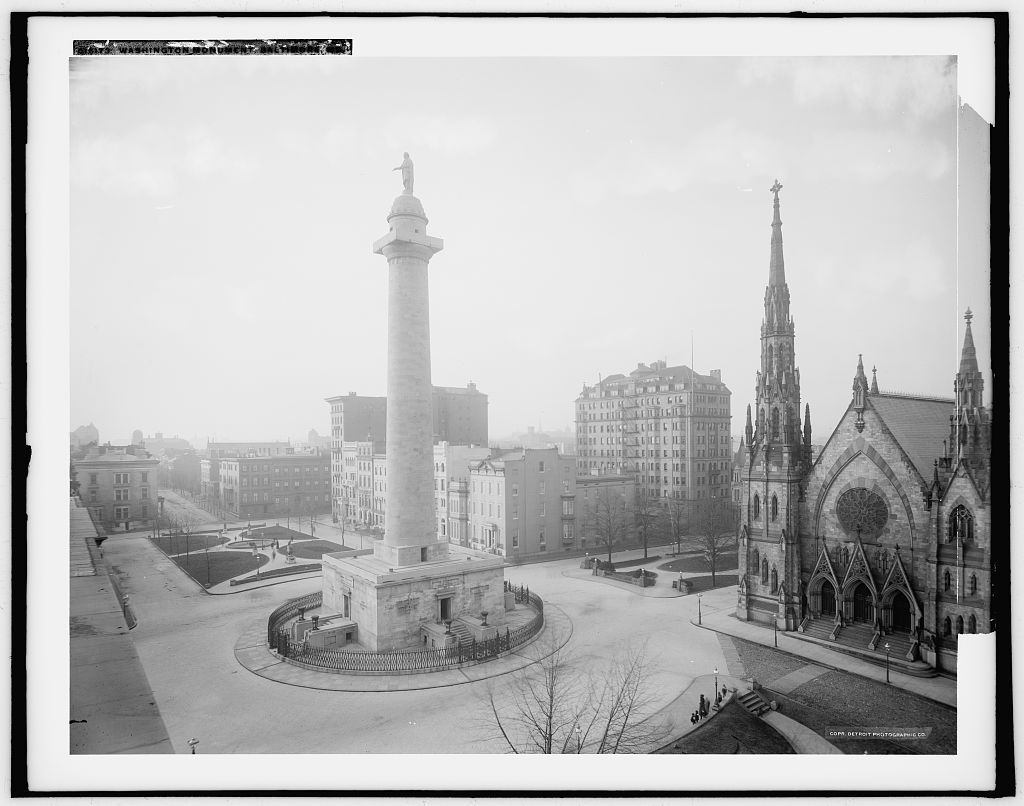
THE 1st WASHINGTON MONUMENT (BALTIMORE, MARYLAND)
Borrowed from Wikipedia, 17, Aug. 2016:
https://en.wikipedia.org/wiki/Washington_Monument_(Baltimore)

History

The Monument, a colossal column, was designed by American architect Robert Mills, who also designed the Washington Monument in Washington, D.C. Construction began in 1815 on land donated by John Eager Howard and the masonry work was completed by 1829. The 178 foot 8 inch doric column holds a ground-floor gallery offering digital exhibits about the construction of the Monument and the history of Mount Vernon Place. Climbing the 227 steps to the top provides an excellent view of the city from the historic neighborhood where it is located. Its neighbors include the Peabody Institute and The Walters Art Museum.

The glorification of Washington began long before his death in December 1799. Congress had first announced a desire for a sculpture in his honor in 1783 and, after his death, revived the idea of a memorial. However, these expressions of honor in the national capital floundered and would not be realized for decades. A monument honoring Washington in Baltimore was first proposed as early as 1807, and in 1809 a Board of Managers of private citizens formed to commission and fund the monument intended to be erected in Courthouse Square on Calvert Street (today's Battle Monument Square). In 1810, the first lottery authorized by the Maryland General Assembly, was held. In 1813 an architectural competition was announced with a $500 prize to design and build the Monument at a cost of $100,000. Mills's design was chosen in 1814, the architect having taken pains to demonstrate to the Board of Managers that he was the first native born American with architectural training. The cornerstone was laid on July 4, 1815.[1]

Mills's competition-winning designs included rich ornamentation, six iron galleries dividing the exterior into seven sections with text and images on each level highlighting important moments in Washington's life. An interior spiral staircase led to the top, where surmounting the column Washington was depicted in a quadriga. Concerns over the expense of this design, as well as its projected height caused changes in not only its design, but location. Resident of Courthouse Square feared the tall column would fall on their houses in the event of some natural disaster, so a new location was found in Howard's Woods, north of the city, and a 200 square foot land donated by Revolutionary War hero John Eager Howard.

By the time the Monument's cornerstone was laid in Howard's Woods in 1815, Mills had significantly simplified the design as depicted in an account of the July 4 ceremony.[1] The design of the completed column is very similar to the Colonne Vendôme, which ultimately derived from Trajan's Column and was adopted in this time of Neoclassicism in American architecture.

The dignified cornerstone ceremony was overseen by the Monument’s Board of Managers. Board President James Buchanan observed that the city of Baltimore had not only “the glory of being the first to erect a monument of gratitude to the father and benefactor of our country,” but that it had a “peculiar propriety” in erecting “this first expression of national gratitude,” because of its successful defense against the British during the Battle of Baltimore the previous fall.[2]

At the ceremony it was declared that the Monument was to stand as “memorial of the blessings and advantages that our country derived from the character of and conduct of that personage whose name it is to bear, and whose virtues it is to perpetuate.” Following speeches, the cornerstone was laid by Levin Winder, then Governor of Maryland and head of the Maryland Freemasons, in a dignified masonic ceremony. The entire proceedings were printed in the local newspaper, picked up by newspapers in other major cities, and published in a souvenir booklet with illustrations.[2]

Almost from the moment the cornerstone was laid, and particularly as the structure began to rise out of the ground (the first marble was laid in 1816), the Monument was a destination and an active memorial. In June 1817, during President James Monroe’s visit to the city, his itinerary included a visit to the Monument. Construction sites in the early nineteenth century were not what they are today, and during the building period it is clear the Monument was visited inside and out. As early as 1819 guests were leaving evidence of their visit in the Monument’s subterranean vaults. By shortly after 1820 with the column proper largely complete with its integral interior staircase, visitors were climbing to the top. New York newspaper editor Nathaniel H. Carter visited in February 1823 and climbed to the top, escorted by a boy with a candle, to take in the views of the city.[3]

The monument, constructed of marble from three quarries in Baltimore County, Maryland, rises 178 feet 8 inches and consists of three main elements: a low, square base containing a gallery; a plain, unfluted column; and, atop the column, a standing figure of Washington. The marble was sourced from three quarries: the base from General Charles Ridgely's quarry, the column and other details from Scott's quarry, and the statue from the quarry of Mrs. Frances D. T. Taylor.[4]

Washington is depicted on the top of the Monument resigning his commission as Commander-in-Chief of the Continental Army, an act which took place in the Maryland State House on December 23, 1783. The statue was carved by Italian-born sculptor Enrico Causici, who previous to his work on the Monument had been employed carving reliefs for the United States Capitol. William Rusk, in his book Art in Baltimore: Monuments and Memorials, tells the following story about the raising of Causici's marble statue of Washington in 1829. "Tradition recalls a prodigy occurring when the statue was raised to the summit of the monument - a shooting star dashed across the sky and an eagle lit on the head of the settling general."

Details added to the Monument in the 1830s include the bronze inscriptions on all facades documenting eight principal events in George Washington's life, including his military and presidential career. Former President John Quincy Adams assisted the Monument's Board of Managers in determining the wording of these events. The interior of the Monument was stuccoed at this time and exterior wood doors installed, painted to imitate ancient Roman bronze doors. The cast iron fence around the base was also designed by Mills and added in 1838. It contains symbolic references to the Maryland and the strength achieved through the union of the original thirteen colonies.[1]


Other memorials to Washington were erected in Maryland and in the nearby national capital, including the one now in Washington Monument State Park (near Boonsboro, Maryland and the Appalachian Trail), which was first constructed in 1827.[5] The Boonsboro monument as it now stands reflects at least two rebuildings after the structure had fallen into ruin. In 1848 Mills's Washington Monument in the national capital was begun, but it would not be completed and dedicated until 1885. Because of this, for decades the Baltimore Washington Monument served as a leading symbol of American pride and gratitude towards George Washington, as a founding father and the first President of the nation. Mid 19th century maps, for instance, pair the Baltimore column with the Capitol building because the Washington, DC monument had only just begun.


Lighting of the Washington Monument

Since 1971, the city has held the annual "Lighting of the Washington Monument" during the first Thursday in December. A holiday village is held prior to the lighting ceremony in the West Square of Mount Vernon Place. Typically, the mayor and his or her family flips the switch for the lights, followed by a fireworks show. After the lighting, the holiday lights remain on the monument until after Christmas Day.

Cultural reference
The Monument is referenced by Herman Melville (as Ishmael) in Chapter XXXV (The Mast-Head) of Moby-Dick, "Great Washington, too, stands high aloft on his towering main-mast in Baltimore, and like one of Hercules' pillars, his column marks that point of human grandeur beyond which few mortals will go." In the show Ace of Cakes the star Duff does the ceremonial lighting of the Monument. He was quoted saying that Baltimore's monument was first, better, cooler, and lights up. The Hollywood film ...And Justice for All has a scene of Al Pacino running around the monument. The film The Bedroom Window, directed by Curtis Hanson, is set largely in Mount Vernon and is about an attempted murder that takes place at the base of the monument. In 1998, an opening scene to the movie Pecker was filmed in front of the Washington Monument. In audio commentary that accompanies the DVD, director John Waters states that the photo the film's titular character (played by Edward Furlong) takes of the monument is "the oldest dirty joke in Baltimore" due to the resemblance of Washington's extended arm to a large phallus when viewed from the angle at which the photo is taken. The TV show House of Cards includes some scenes of the monument and surrounding area such as the Peabody Institute and the Belvedere.

Restoration

The Monument was closed in June 2010 by the City of Baltimore for safety reasons, according to articles in the Baltimore Sun and Washington Post newspapers. Missing mortar and rusted support brackets were among specific safety concerns. Several months later, a driver ran a 1997 Chrysler van through the southeast corner on October 30, 2010 and damaged roughly 15 feet of the fence.[6] While reports initially indicated the Monument's closure would last three months, it was later determined that reopening would not take place until a renovation was completed. In 2012 the City of Baltimore entered into a partnership agreement with the Mount Vernon Place Conservancy to restore, maintain, and manage the Monument and parks squares of Mount Vernon Place.

The monument has undergone a $5.5 million restoration by the Mount Vernon Place Conservancy which began in January 2014. It was reopened and rededicated on July 4, 2015, in celebration of the bicentennial of the cornerstone being laid.[7]

1815 Cornerstone rediscovered and 1915 Time Capsule discovered

During the monument's restoration two time capsules were discovered, the Monument's original 1815 cornerstone and a 1915 Centennial time capsule. Although the Monument's cornerstone had long been known to exist, its exact location was unknown. The 1915 Centennial time capsule, however, had been forgotten to time. The first to be discovered, the 1915 time capsule, was a sealed copper box that had been placed behind a plaque in the monument during the centennial celebrations in 1915. It was discovered in October 2014.[8]

In February 2015, during digging for a sewage tank, a second time capsule, the Monument's original cornerstone, was discovered containing three well preserved glass jars stuffed with and surrounded by newspapers from July 1 and July 3, 1815, the days right before the laying of the cornerstone. The cornerstone was a nearly perfect granite cube with a marble lid, weighing between 1,000 and 1,500 pounds (roughly 450 to 700 kg). Besides the jars, the cornerstone contained a panel carved by local stonemasons and carvers of the time, and is expected to contain additional items, including coins and a metal plate. Like the 1915 capsule, the cornerstone contents were taken to the Walters Art Museum for analysis.[9][10]

The contents of the 1815 cornerstone were fully revealed, and the 1915 time capsule opened, on June 2, 2015, at the Walters Art Museum. Among many interesting artifacts, the 1815 cornerstone contents included a copy of the United States Declaration of Independence printed in the (Baltimore) Federal Gazette on July 3, 1815, the day before the cornerstone was laid. The newspaper was folded open to the page printing the Declaration, and appears to be the last item placed in the stone. This inclusion suggests that to those who built the Monument in 1815, it was not just the first monument to honor America's founding father, George Washington, but also one of the earliest American monuments celebrating American national independence.[11]

Historic designation

The Washington Monument is the centerpiece the public squares of Mount Vernon Place, which comprise the Mount Vernon Place National Historic Landmark District, designated in 1971.[12] The Historic District is in turn within the Mount Vernon neighorhood of Baltimore, and the Baltimore National Heritage Area.[13]

References

1.^ Jump up to: a b c Mount Vernon Place Conservancy, “Historical Timeline: Washington Monument and Mount Vernon Place” http://mvpconservancy.org/digital-exhibits/
2.^ Jump up to: a b See the full 1815 account https://archive.org/details/authenticaccount00prat
3.Jump up ^ “Arrival of the President,” June 2, 1817, Baltimore Patriot. During the 2014-15 restoration graffiti dating as early as 1819 was found in the Monument’s basement. See http://articles.baltimoresun.com/2014-02-07/news/bs-md-ci-monument-discovery-20140207_1_lance-humphries-mount-vernon-place-conservancy-washington-monument. See “Baltimore,” which prints Carter’s account of his visit, Feb. 19, 1823, Baltimore Patriot.
4.Jump up ^ http://mvpconservancy.org/digital-exhibits/ Mount Vernon Place Conservancy, “Washington Monument, Monument Facts”
5.Jump up ^ "Washington Monument State Park". State of Maryland Department of Natural Resources. Retrieved November 25, 2012.
6.Jump up ^ Washington Monument Baltimore | Van destroys section of Baltimore's Washington Monument fence - Baltimore Sun. Articles.baltimoresun.com (2010-10-30). Retrieved on 2013-07-15.
7.Jump up ^ Wenger, Yvonne. "Washington Monument set to undergo $5 million in repairs," The Baltimore Sun, Friday, October 18, 2013.
8.Jump up ^ Time capsule discovered at Baltimore's Washington Monument, Rob Roblin, wbaltv.com, October 30, 2014.
9.Jump up ^ Baldwin, Brooke. "200-year-old time capsule discovered," CNN, Wednesday, February 18, 2015.
10.Jump up ^ Historic cornerstone found at Washington Monument, Kate Amara, wbaltv.com, February 18, 2015.
11.Jump up ^ http://www.cnn.com/2015/06/02/travel/baltimore-washington-monument-time-capsule-feat/
12.Jump up ^ Staff (2007-01-23). "National Register Information System". National Register of Historic Places. National Park Service.
13.Jump up ^ "Baltimore National Heritage Area Map" (PDF). City of Baltimore. Retrieved March 11, 2012.


Borrowed from Maryland Historical Society on 17, Aug. 2016: https://www.mdhs.org/findingaid/washington-monument-papers-1810-1843-ms-876

Washington Monument Papers, 1810-1843, MS. 876

Washington Monument Papers, 1810-1843

Maryland Historical Society

(Text converted and initial EAD tagging provided by Apex Data Services, March 1999.)

Washington Monument Papers, 1810-1843

Maryland Historical Society

Contact Information:

Manuscripts Department

Maryland Historical Society Library

201 West Monument Street

Baltimore MD 21201-4674

410.685.3750

specialcollections@mdhs.org

www.mdhs.org

Descriptive Summary

WASHINGTON MONUMENT PAPERS

MS 876

Maryland Historical Society

Baltimore MD 21201-4674

Harriot Weiskittel

February 1979

Scope and Content

The collection includes correspondence, financial records, minute books, visitors' books, drawings, contracts, maps.

The collection is especially rich in correspondence. There are numerous folders of letters from Robert Mills, which span the years 1814 (when Mills submitted his winning plan for the Monument) to 1839 when the work was virtually complete. Mills’ letters, written frequently and at great length, form an invaluable corpus of information regarding the progress of work on the Monument (including changes in its design necessitated by financial stringencies) as well as providing an autobiographical account of Mills’ other architectural commissions and his own impecunious state.

From 1825 the Board of Managers submitted annual reports to the Treasurer of the Western Shore in which the Board summarized the progress of work, presented the accounts and estimated the amount of work and money required for the following year. The collection includes eight folders of correspondence and reports exchanged between the Board and the Western Shore Treasury during the years 1825-1843.

The numerous invoices, receipts, accounts, bills etc. in Box 4 amply document the expenses incurred during the construction of the Monument.

Mills’ original drawings of his plan for the Monument may be found in Box 3 and his `studies for the surmounting of the Washington Monument Column' with numerous sketches of the inscriptions and proposed trophies are inserted in the volume `Rejected Designs of the Washington Monument.' located in 3 oversize folders.

Principal correspondents include Robert Mills, Robert Gilmor, Jr., Enrico Causici, William Steuart, David Winchester and George MacKubin.

BOARD OF MANAGERS OF THE WASHINGTON MONUMENT

James A. Buchanan (President 1814-1819)

David Winchester (Treasurer)

John Comegys (President 1810-1814)

James Calhoun, Jr.

Nicholas G. Ridgeley

James Williams,

George Hoffman

James Partridge

Robert Miller

Washington Hall

Isaac McKim

Lemuel Taylor

Robert Gilmor, Jr. (President 1819-18)

Fielding Lucas, Jr.

John Frick

James Barroll

Edward I. Coale

Benjamin H. Mullikin

Nathaniel F. Williams

Levi Hollingsworth

James Cocke

William Gwynne

William H. Winder

Eli Simkins (Secretary, but not a member)

Introduction

The papers span the years 1810-1843, with five additional folders which date from 1915-1916, the centennial of the laying of the cornerstone of the Monument.

The provenance of these papers is not certain, but MS. 2008 (the papers of the Maryland Historical Society) contains a letter from William F. Lucas, 14 June 1880, who donated to the Society papers which comprise all those connected with the `Washington Monument' from its incipiency. William Lucas inherited the papers from his father, W.Lucas Jr., the last survivor of the original Board of Managers.

Many of the letters in this collection are addressed to Robert Gilmor Jr., in his capacity as President of the Board of Managers, and thus it is possible that some of the papers reached the Society through donations by Gilmor's descendents.

This collection is an amalgation of three collections - 876, 876.1 and 876.2. After conservation the papers were brought together and arranged in one sequence.

Lottery tickets were transferred to the Society's Coin and Currency Collection.

Numerous books and articles have been written on the history and construction of the Washington Monument but a brief recapitulation of major dates and events may be useful here.

In 1810 a petition extolling the virtues of George Washington and his services to the country was presented to the Maryland State Legislature with the request that a memorial be erected to his memory. The outcome of this appeal was the passage of an Act on 6 January 1810, authorizing the raising of a sum of money by lottery, not to exceed $100,000, for the construction of a monument.

The Act also created a Board of Managers which was given the authority to oversee the lottery and to direct the building of the monument. John Comegys, the author of the original petition to the Legislature, was elected President of the Board at its second meeting, February 1810. A Lottery Committee was appointed and for three years the Board's activities and attentions were directed to supervising the Monument Lotteries.

In 1813 sufficient funds were collected for the Board to offer a prize of $500 for the best plan for the monument. In May 1814 Robert Mills was awarded the prize and appointed architect. A Building Committee was created tosupervise the work of construction.

In 1814 James Buchanan succeeded Comegys as President of the Board after the latter's death in July of that year. On 4 July 1815 the cornerstone of the monument was laid at a site donated by John Eager Howard after the original site (on North Calvert Street) had been rejected in fear that the column might prove dangerous to surrounding property.

The building of the monument continued from 1815 to 1820 when the capital was placed inpposition and the pedestal was mounted to receive the statue. It was not however until 1827 that the Board advertised a competition for a sculpture to be placed on top of the column. The model submitted by Enrico Causici was chosen and in November 1829 his completed statue of George Washington was raised to the top of the column.

In the meantime, Robert Gilmor, Jr. became President of the Board of Managers following the resignation of Buchanan in 1819 and continued to serve in this capacity until the Board was dissolved. The Board of Managers was continually plagued by financial difficulties as lottery receipts were not sufficient to cover construction costs. The sixth, and last, class of the Monument Lottery was held in 1824. After that date, the expenses were met from funds made over to the Board from the proceeds of the State Lottery. By 1843 expenses for the Monument had totalled over $200,000.

Container List

BOX 1

Robert Mills to Board of Managers

1814

Includes Mill’s letter transmitting his entry in the design contest.

Robert Mills to Board of Managers

1818

Letters to Board of Managers from Robert Mills, William Steuart, J. Donnell

1819

Robert Mills to Board of Managers

1820

Letters to Board of Managers from R. Mills, William Steuart, Enrico Causici

1823 - 1825

Letters to Board of Managers from Robert Mills, William Steuart, J. Brewer (House of Delegates)

1826

Robert Mills to Board of Managers

1827

Includes letter from N. (?) Gevetot forwarded by Mills.

Enrico Causici to Board of Managers

1827

Letters to Board of Managers from Enrico Causici, William Steuart

1828

Enrico Causici to Board of Managers

1829

H. Castro to Board of Managers

1829

Robert Mills to Board of Managers

1829

Letters to Board of Managers from J.T. Ducatel, J.D. Woodside

1829

Robert Mills to Board of Managers

1830

Letters to Board of Managers from E. Causici and H. Castro

1830

Robert Mills to Board of Managers

1831

Robert Mills to Board of Managers

1832

Robert Mills to Board of Managers

1833

Robert Mills to Board of Managers

1834

Robert Mills to Board of Managers

1835

Robert Mills to Board of Managers

1836

Robert Mills to Board of Managers

1837

Robert Mills to Board of Managers

1838 (March-June)

Robert Mills to Board of Managers

1838 (July-Dec.)

Robert Mills to Board of Managers

1839

Misc. letters to Board of Managers

1810 - 1843

Copies of letters from Board of Managers to Enrico Causici

1827-1829, 1833

Letters to Robert Mills from A. Copellana and Robert Gilmor

1827, 1829

Letters to William Steuart from Robert Gilmor, Robert Mills, and unidentified

1821, 1828, 1834

Copies of letters from Board of Managers to the Treasurer of the Western Shore

1827, 1831

B. Harwood (Western Shore Treasurer) to Board of Managers

1825

Copies of letters from Board of Managers to B. Harwood

1825

George MacKubin (Western Shore Treasurer) to Board of Managers

1826-1835

George MacKubin (Western Shore Treasurer) to Board of Managers

1836-1843

Copies of letters from Board of Managers to George MacKubin

1826-1835

Copies of letters from Board of Managers to George MacKubin

1836-1842

J.S. Owens (Western Shore Treasurer) to Board of Managers

1843

Copies of letters from Board of Managers to J.S. Owens

1843

Copies of letters from Board of Managers to John Gittings (Commissioner of Loans)

1843

Copies of correspondence from Board of Managers and William Steuart to State Legislature

1825 - 1830

Copies of letters from Board of Managers to State Legislature

1833-1842, n.d.

Correspondence between members of the Board of Managers

1819 - 1834

BOX 2

Copies of resolutions passed by the Maryland General Assembly

1834, 1843

Minutes of meetings of the Board of Managers. Includes copies of official resolutions passed by the Board.

1816-1828, 1830

Copy of advertisement for sculptor to design tropies for the Monument.

1839

Ms. list of contents of the Washington Monument papers.

n.d.

Contracts (with brick-makers, carpenters, stone masons, lime merohants etc.) for the construction of the Monument.

1815-1816

Contracts for the construction of the Monument

1835-1838

Printed material (copies of official acts by the legislature, annual reports of the Board of Managers)

1825-1842

Washington Monument Lottery

(11 folders)

1810-1826

Includes minutes of the Lottery Committee of the Board of Managers, correspondence, accounts, copies of official acts and resolutions passed by the Legislature, lists of prizes, lists of winning numbers, bonds, promissory notes, memoranda from J.I. Cohen, Jr.

See `Cohen Brothers of Baltimore: Lotteries to Banking', W.R. Luce, Maryland Historical Magazine, 68, pp.288-308, for good description of the Monument Lottery.

Centennial celebrations

(5 folders)

1915-1916

Includes correspondence, photograph of bronze plaque, proof copy of article re history of Monument, correspondence and notes re 1893 petition for removal of iron railing surrounding Monument, correspondence re building of Monument.

BOX 3

“Designs for the Washington Monument by Robert Mills, 1814” (Book was bound in August 1942)

Contains a 5 pp. formal statement of his plan and colored sketches of the principal fronts, of the “second fronts,” plan of the great capital, plan halfway up the capital, plan at the top, 2 plans at the base.

Account Book, 1814-1824. From other end of book, lists of expenditure, 1815-1843.

Volume of “Papers relating to Washington Monument” Includes copy of John Comegys's resolution submitted to the Legislature, copy of petitions submitted to the House of Delegates, minutes of the Board of Managers from February 1810 to March 1815.

Minute Book of the Board of Managers and of the Lottery Committee. Record begins on 23 February 1820 and continues to 14 April 1843 but there are many breaks in the sequence. Book is annotated at top of first page, “The proceedings of the Board prior to this date could not be found after the death of Mr. Simkins its Secretary.” From other end of book, minutes beginning 1 December 1819 and continuing to 23 February 1820.

Book also contains copies of official bills, notes, news clippings, memoranda etc.

BOX 4

Financial records

(32 folders)

1815-1842

Includes invoices, receipts, accounts, bills, estimates of work to be done etc. Record of advertising, supplies and materials, ground rent, labor, debts, income, publicity.

BOX 5

Visitors' Books.

(10 volumes)

July 1835 - May 1838, with covering letter from Robert Gilmor

May 1838 - August 1838

November 1838 - April 1839

April 1839 - July 1839

July 1839 - September 1839

January 1840 - May 1840

May 1840 - June 1840

June 1840 - September 1840

September 1840 - December 1840

December 1840 - April 1841

Oversize Folders, 1 - 3

Volume: “Rejected Designs of the Washington Monument”

Presented April 11, 1881 by John R. Baker of Philadelphia, Pennsylvania

Bound 1820 (Bindings broken; drawings removed 1979)

Contains Washington Monument drawings and inscriptions, Robert Gilmor letter re completion of the Monument, list of members of Washington Monument Lottery Committee, biographical data on George Washington, maps of site of Monument. Items are numbered 1 -25.

OS Folder 1: “Studies for the surmounting of the Washington Monument Column”

#1 – Studies for the surmounting of the Washington Monument Column, scale ½ an inch to 10 feet

#2 – [Four studies for the surmounting of the Washington Monument Column]

#3 – [Study for the surmounting of the Washington Monument Column]

#4 – [Study for the surmounting of the Washington Monument Column]

#5 – [Study for the surmounting of the Washington Monument Column]

#6 – Design for the Washington Monument, Baltimore, Built 185-1829, Photostat

OS Folder 2: Sketches of proposed trophies; Maps of site of Washington Monument

#7 – [Four sketches of proposed trophies]

#8 - [Two sketches of proposed trophies]

#9 – [Site of Washington Monument]

#10 - [Site of Washington Monument]

#11 – [Site of Washington Monument], photocopy

OS Folder 3: Sketches of Inscriptions for Washington Monument; Correspondence; other items

#12 - [Sketch of Inscription for Washington Monument]

#13, 14, 15 –Descriptions proposed for the Four fronts of the Washington Monument

#16 - [Sketch of Inscription for Washington Monument]

#17 - Plan of the description of the Washington Monument

#18 – Description for the Washington Monument on the tablet in the frieze…

#19 - [Sketch of Inscription for Washington Monument]

#20 – French designs for the monument

#21 – Members of the Washington Monument Lottery Committee

#22 – Washington [timeline of George Washington’s life]

#23, 24 – Robert Mills to Sir, not dated

#25 Robert Mills to Robert Gilmor, June 9, 1834


IF YOU HAVE ANY INFORMATION OR PICTURES THAT YOU WOULD LIKE TO SUBMIT, PLEASE E-MAIL:
Salvatore71077@Yahoo.com