HOLLINGSWORTH FAMILY TREE
Cumberland County - North Carolina

HOME

Nash Hollingsworth
1917-1977

Married: 19??
Amanda Huggins
1922-1998

Philander Hollingsworth
1876-1953

Married: ~1900
Mary Ellen Sikes
~1885-1956
John C. Hollingsworth
1830-1913

Married: 25, May 1869
Mary Elizabeth Hales
1852-1929
John (Jno.) Hollingsworth
1794-1850

Married: 25, May 1836
Catherine "Kitty" Anderson
~1815-????

Hollingsworth
Continued...


Click for Larger View


HARLAN AND HOLLINGSWORTH


From Wikipedia, the free encyclopedia - 9,APR.2020 - https://en.wikipedia.org/wiki/Harlan_and_Hollingsworth

Harlan & Hollingsworth was a Wilmington, Delaware, firm that constructed ships and railroad cars during the 19th century and into the 20th century.

Founding:
Mahlon Betts, a carpenter, arrived in Wilmington in 1812. After helping construct many prominent buildings in the city, Betts branched out into foundry work in 1821. In 1836, Betts partnered with Samuel Pusey (a machinist) and began manufacturing railcars at a plant on West and Water Streets in Wilmington. The next year, cabinetmaker Samuel Harlan joined the firm, then known as Betts, Pusey & Harlan. By 1839, the company claimed to have manufactured 39 passenger and 28 freight cars over the previous two years. The next year, they hired Jacob F. Sharp, a former house carpenter, to build railroad cars. He would rise to become foreman at the plant, and eventually co-founded the rival firm of Jackson and Sharp.

In 1841, Elijah Hollingsworth, brother-in-law of Harlan, bought out Pusey, and the firm became known as Betts, Harlan & Hollingsworth. Pusey later formed competing Pusey and Jones. In 1849 Mahlon Betts withdrew from the firm, which became simply Harlan & Hollingsworth; J. Taylor Gause was admitted as a partner in 1858, and the company became known as Harlan, Hollingsworth & Co..

For more reading material about the Harlan and Hollingsworth's family ties,
check out this great research by Sadie Greening Sparks at

http://www.sadiesparks.com/sparksindex.htm
You'll see a Harlan link and some Hollingsworth links towards the middle section.
If this link ever fails, please let me know.


Shipbuilding:
Harlan & Hollingsworth's experience with railcars and other ironwork led them to become early experimenters in iron shipbuilding. In 1842 the company hired Alexander Kelly to supervise all the millwright work. In 1843, under the encouragement of Samual Harlan, the company started engaging in marine engine building and repair. Their first ship-related project was repairing the cylinder and other machine parts of the steamboat Sun. This small step was the beginning of what would become one of the first iron shipyards in the United States.

Harlan & Hollingsworth's expanded slowly but steadily into iron shipbuilding. Only nine ships were built between 1841 and 1851, with most of the company time taken with railroad car building and general repair work. In 1843 the company leased a launching berth on the banks of the Christiana River. The facilities at this property were limited, so all the work forming iron plates, bars, and fasteners was done at their main shop on Front and West Streets. The launch slipway was 200 feet long and could only accommodate vessels of 600 tons maximum, but this was deemed adequate for the needs of the time.

The first two hulls built by the company, the Ashland and Ocean, were two of the earliest iron steamboats to be constructed in the United States. They were delivered to George Aspinwall of Philadelphia in 1844. That same year the company built the Bangor, which is credited with being the first seagoing iron propellor steamship built in the United States.

By the early 1850s the company began to rely less on wood ship or railcar building for its income. Machine shops, office buildings, wharves, carpenter sheds, boiler shops, blacksmith shops and cranes were added in the first five years of the decade. As the firm's reputation grew, more orders for steamboats came in from across the country. Charles Morgan, a New York shipping magnate, purchased his first ship from Harlan in 1856. Morgan would eventually become one of the largest customers for Harlan & Hollingsworth, ordering over 31 vessels by 1878.

Business Growth:
This chart give an indication of the economic progress of the company from 1836 to 1860:

1836 - 20 Employees - $6,500 Gross Value
1838 - 45 Employees - $63,374
1842 - 120 Employees - $40,531
1850 - 225 Employees - $159,742
1855 - 280 Employees - $239,662
1860 - 630 Employees - $580,427
(Society of Naval Architects, 1943)


Civil War:
Harlan and Hollingsworth was, by the time of the American Civil War, the dominant iron shipbuilder in Wilmington, and the most prolific iron shipbuilder in the United States. By 1860 the company had built 75 iron hulls, mostly steamships along with a handful of barges. (Brown, 1951) During the Civil War the company won contracts for the construction of three monitors for the government (Patapsco, Saugus, and Napa). The Navy, however, ordered many last-minute design changes to these vessels resulting in delays while the changes were incorporated into the construction. The extra expenses incurred reduced profits, and as a result the company became reluctant to bid on government contracts. In 1863, Jacob Sharp left their employ to form Jackson & Sharp, another car-building firm, with Job Jackson.


PostWar:
In 1866 Elijah Hollingsworth died in a shipyard accident. His death greatly affected Samuel Harlan, so that shortly thereafter the partnership was dissolved and the enterprise incorporated as The Harlan & Hollingsworth Company. Harlan & Hollingsworth thrived despite competition from Jackson & Sharp and other Wilmington yards, in part because of their diversified production of railroad car building and shipbuilding. However, the Panic of 1873 and the death of Charles Morgan (their largest customer) induced the company to undertake government contracts again. These included the construction of the sloop Ranger and the long (16 year) construction of the "New Navy'' monitor USS Amphitrite (BM-2). Despite this experience Harlan & Hollingsworth constructed three more torpedo boat destroyers for the Navy, the Stringham, Hull, and Hopkins.

Other notable vessels built by Harlan & Hollingsworth include Mischief, winner of the fourth America's Cup in 1881. Another notable vessel they built in 1887 was the Yampa, which lead to other ships built for the German Emperor William II.[1][2][3]

The company followed Jackson & Sharp into narrow gauge car building, but were not in the forefront of steel car construction. In the 1880s orders for ferries and coastal steamships started picking up again, so much that by the end of the 19th century, the company was the largest employer in Wilmington. In 1896-1897 they built the Catawissa; it was listed on the National Register of Historic Places in 1996.[4] Also on the National Register is the Rosinco, built by Harlan and Hollingsworth in 1916.


Bethlehem Steel Era:
On December 10, 1904, the company was acquired by Bethlehem Steel and operated as part of their shipbuilding division. The name changed from Harlan & Hollingsworth to the Harlan Plant of Bethlehem Steel. The shipyard closed in 1926, although it was reopened for a time during the Second World War and part of the shipyard was used by the Dravo Corporation until 1964. Railcars were built on the site until 1940, and parts for railroad cars until 1944. Most of the company's buildings have been demolished for new development, but the office building survives and was added to the National Register of Historic Places in 1979.[5]


References
1. Leslie 1901, p. 540.
2. Bigelow 1902, p. 121.
3. SA 1902, p. 141.
4. "National Register Information System". National Register of Historic Places. National Park Service. March 13, 2009.
5. "National Register Information System". National Register of Historic Places. National Park Service. July 9, 2010.
David B. Tyler, The American Clyde, University of Delaware Press, 1958.
Richard Urban, The City that Launched a Thousand Ships, Cedar Tree Books, Wilmington, DE, 1999.
"History of Harlan & Hollingsworth". Archived from the original on 2007-03-08. Retrieved 2006-12-31.
Henry T. Gause, Semi-Centennial Memoir of the Harlan and Hollingsworth Company, Wilmington, Del.: N.p., 1886.
Society of Naval Architects and Marine Engineers, Issue no 21, 1943.
Alexander Crosby Brown, Notes on the Origins of Iron Shipbuilding in the United States, 1825-1861, Masters Thesis, College of William and Mary, Williamsburg, Virginia, 1951.

Sources
Bigelow, Poultney (1902). Outing. Outing Publishing Company.
Leslie, Frank (1901). The American Magazine, Volume 53. Frank Leslie Publishing House.
SA (1902). Scientific American. Scientific American, Incorporated. Coordinates: 39°44'13.26?N 75°33'25.68?W

External links
Historic American Engineering Record (HAER) No. DE-8, "Harlan & Hollingsworth Company Factory"
Soo Line #920, a Harlan & Hollingsworth railway coach currently awaiting restoration


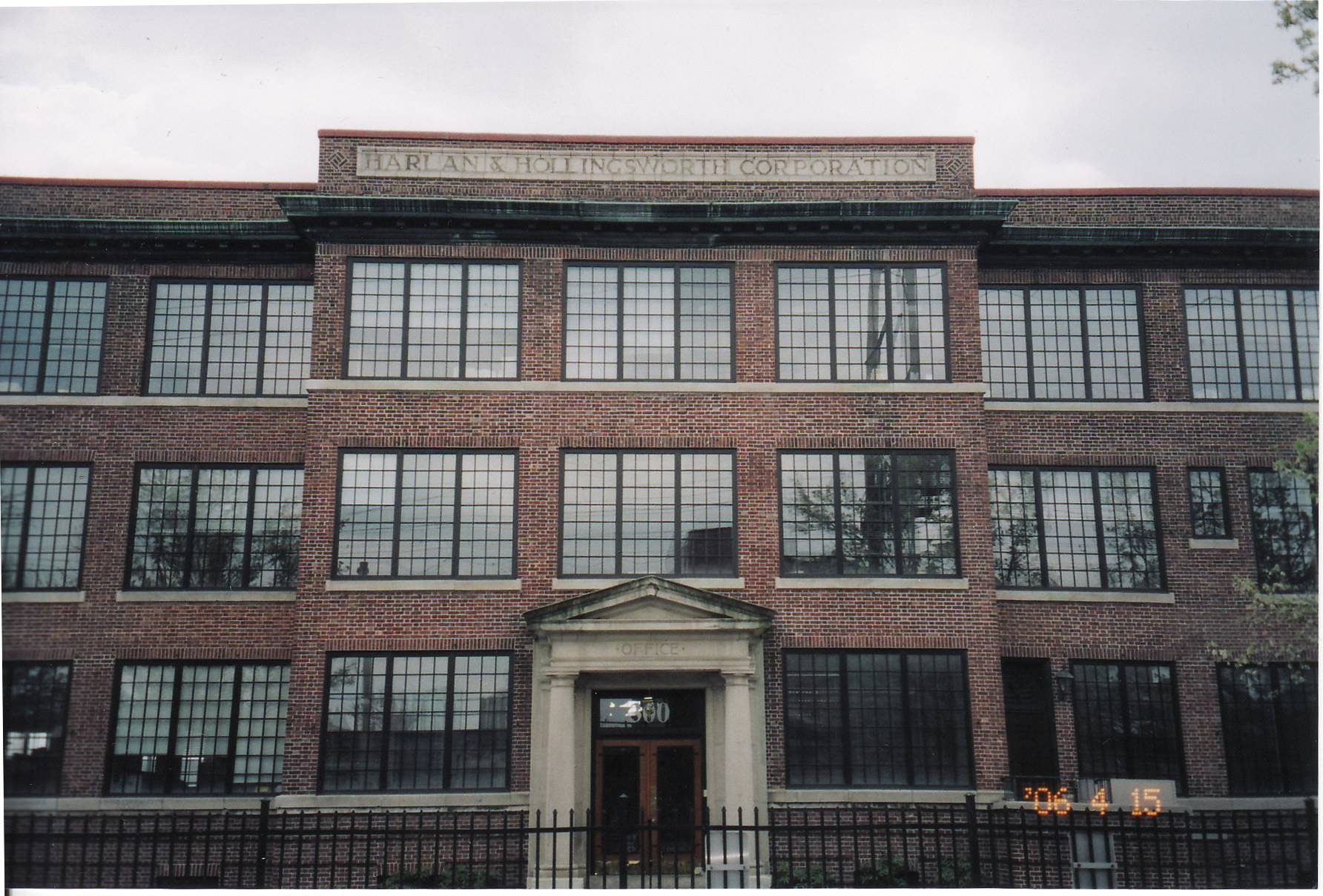
HARLAN AND HOLLINGSWORTH OFFICE BUILDING


Click for Larger View


The Harlan and Hollingsworth Office Building is a historic office building located in Wilmington, New Castle County, Delaware. It was completed in 1912, and stands on the corner of West St. and the Wilmington Rail Viaduct. It is a three-story, detached, rectangular brick-faced building with two small rear wings in the Colonial Revival style. It features two large, decorated copper-faced bay windows projecting from each face of the right corner of the second story.[2]

By 1910, existing office facilities at the Harlan Plant of Bethlehem Steel (formerly Harlan and Hollingsworth) had become inadequate, and work started on a new office building. It survived the closing of the Harlan Plant in 1944, and once housed laboratories for Gates Engineering Company. The building was purchased by 100 South West Street Associates in 1991 and restored.[3]

It was listed in the National Register of Historic Places in 1979.[1]

References:
1. "National Register Information System". National Register of Historic Places. National Park Service. July 9, 2010.
2. Jean Athan (November 1978). "National Register of Historic Places Inventory/Nomination: Harlan and Hollingsworth Office Building". and Accompanying eight photos
3. Thompson, Priscilla M.; O'Byrne, Sally (1999). Wilmington's Waterfront. Great Britain: Arcadia Publishing. ISBN 0-7385-0304-5.

External Links:
Historic American Engineering Record (HAER) No. DE-8, "Harlan & Hollingsworth Company Factory, 100 South West Street, Wilmington, New Castle, DE"


HARLAN & HOLLINGSWORTH PICTURES:


From Library of Congress

Map Left
Map Right
1849-1896 Ship Plans
Masting Sheers
Map
Interior of Sleeping Car (train)
Upper Half of Machine Shop
Ship at Simpson Patent Dry Dock
Ship "Anson M Bangs"
Ship "Sandy Hook"
Interior of Club Car (train)
Exterior of Club Car (train)
Boilers for Freight Steamers
Ship "Bangor"
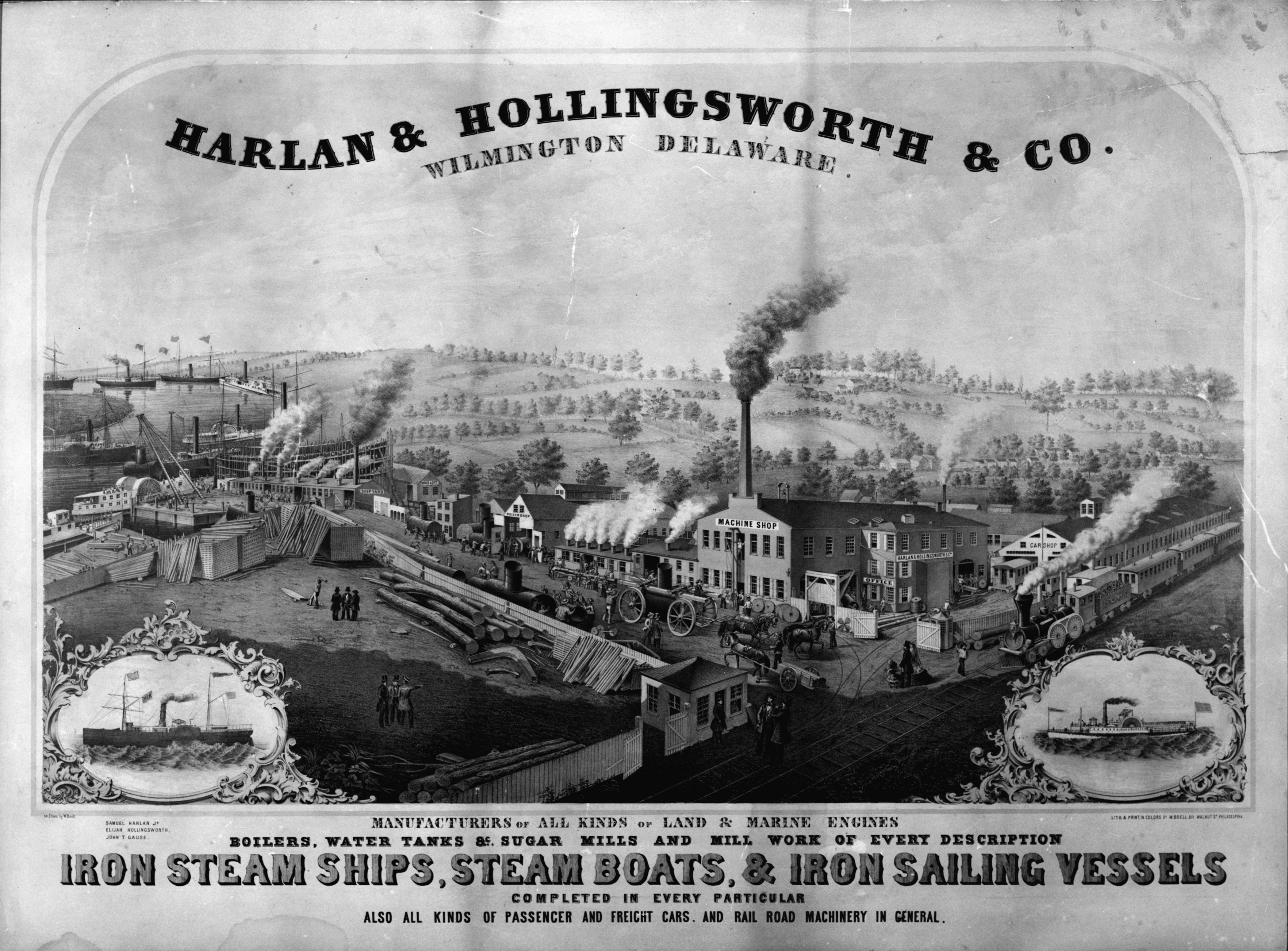
Harlan & Hollingsworth flyer
Plant view from harbor
Shipyard map
Portable Steam Engine
Shops map
Map
Building Sketch
Early Cars Sketch
Railroad Car Works
Iron-ship Building Est
Picture of Sleeping Car
Picture of ship "Alva"
1876 Advertisement
1894 Advertisement Shipyard Article

More pictures of the later years of Harlan & Hollingsworth (1902-1916) can be see at:
https://digital.hagley.org/1699?page=1

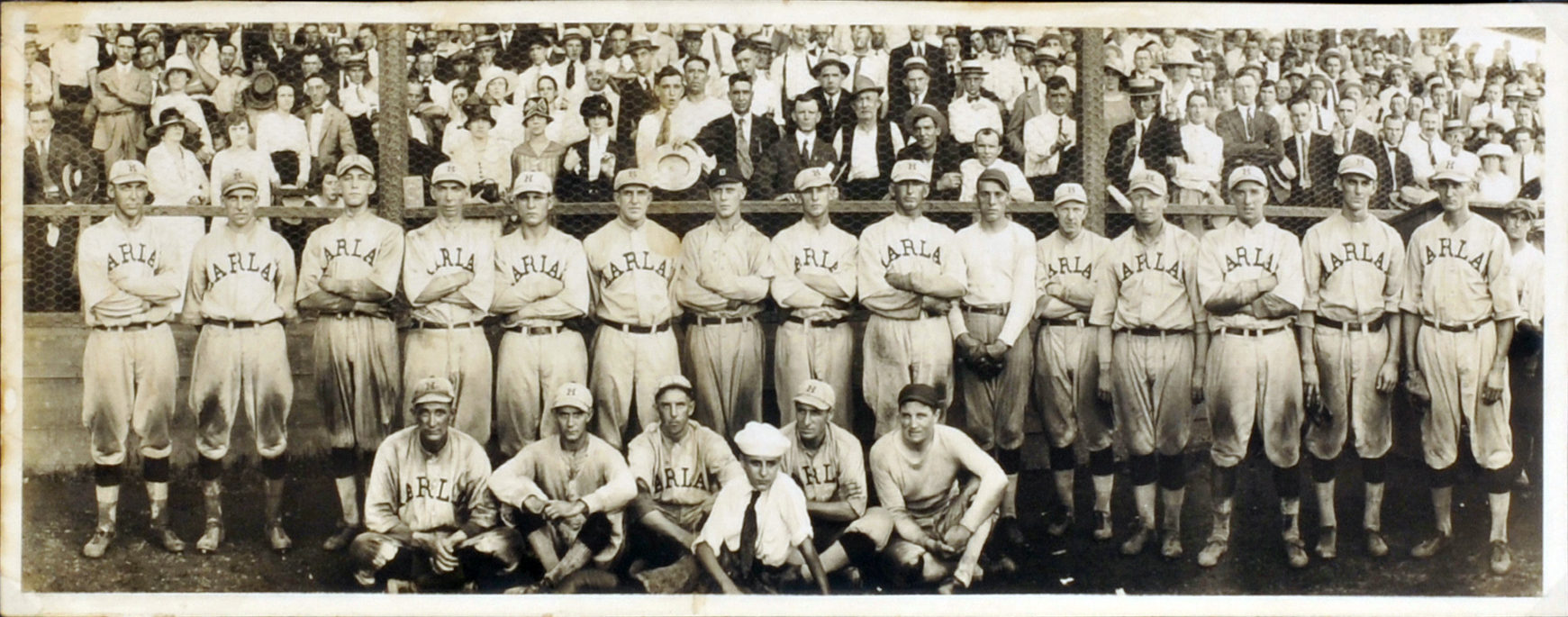
During WW1, a "work or fight" policy was set out. A famous baseball player by the name of "Shoeless Joe Jackson" was working in the Harlan & HOllingsworth Co. factory. This didn't stop him playing baseball though. You can see him in this picture below, playing for the factory's baseball team. For those who don't know, he got his name when his new shoes were not broken in and so he played in his stockings for just that game, but it was enough to make the name stick. Also, he was kicked out of professional baseball due to the 1919 Black Sox Scandal where the World Series was rigged with other teammates who went to some big gamblers. Back then, it wasn't too abnormal to find rigged games though, but the league set the example that year and kicked several people out. Unfortunately, Joeseph Jackson was still very young and doing well in his baseball prime during that time.


Shoeless Joe Jackson playing for Harlan & Hollingsworth Co. during WW1 (standing 9th from the left)
CLick picture for a larger view...


See these links for more info on Jackson:
Society for American Baseball Research
"8 Myths"
Net54Baseball Forum


IF YOU HAVE ANY INFORMATION OR PICTURES THAT YOU WOULD LIKE TO SUBMIT, PLEASE E-MAIL:
Salvatore71077@Yahoo.com